JLL Sydney Trains - Tenant WHS Guide

Your Tenancy WHS and Compliance Guide

JLL Property Management carries out regular site safety inspections as a part of the tenancy agreement to support you in maintaining proactive Work Health and Safety compliance and to offer assistance with the items identified below.

Please refer to this guide to help assist you and your team, in understanding your responsibilities in maintaining safety and compliance within your establishment. Together, we can create a safe work environment for all.

Annual Fire Safety Statements (AFSS)

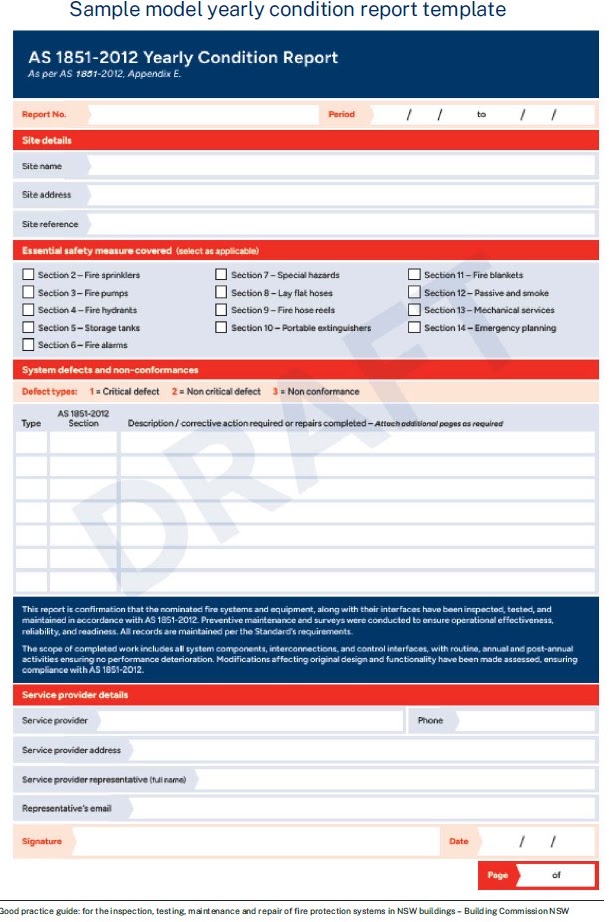
Annual inspection and certification of fire safety measures by a qualified practitioner.

Frequency: Every 12 months (Mandatory by Law).
Why: Ensures all fire protection systems (alarms, exit pathway, extinguishers etc) in your site are operational and comply with regulations whilst helping keeping the public and property safe.
How: Book a certified fire safety assessor to inspect, service the fire equipment on site and issue an Annual Fire Safety Statement (AFSS).
Note: Display the certificate near the entrance or staff area, store it safety where it can be easily accessed and is recommended to provide JLL Property Management a copy of this certificate.

Failure to comply with AFSS Requirements can result in fines, legal penalties, increased risk of fire and breach of your tenancy agreement (lease)

Fire Safety Equipment Maintenance

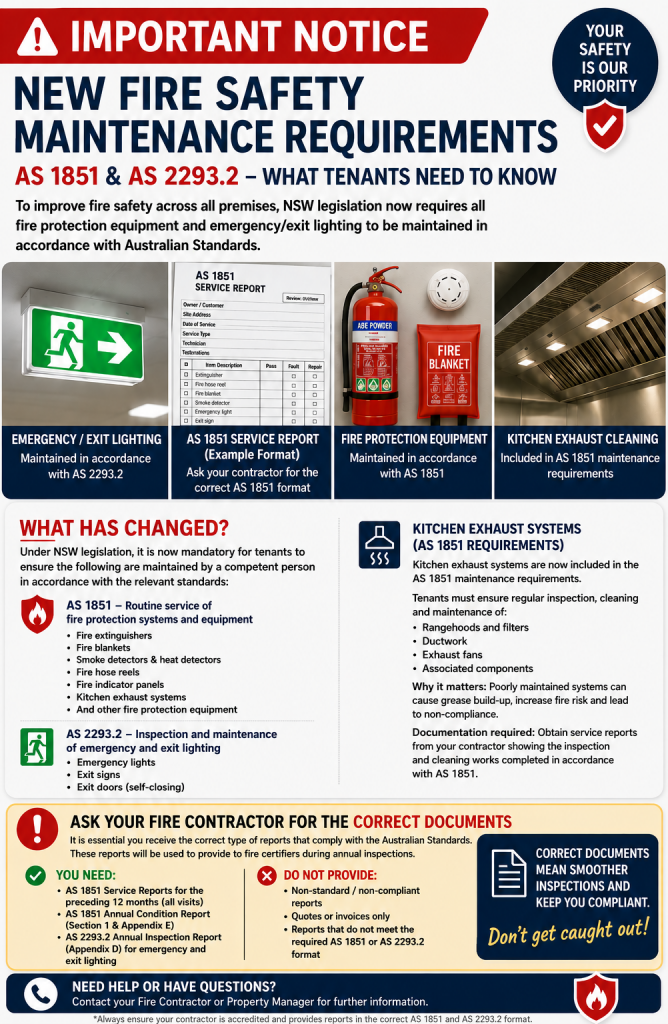
Routine inspections of Fire Safety Equipment of the premises by a qualified practitioner as required under Australian Standard AS 1851


What: Inspect and service extinguishers, hose reels, blankets, emergency lighting and any special site-specific fire protection equipment installed for your premises.

Frequency: Every 6 months (minimum).

Why: Faulty fire equipment can fail during an emergency. Regular maintenance helps ensure fire equipment is ready to fight fires and help save lives.

How: Contact a licensed fire protection contractor to service the equipment on a regular basis.
Note: Keep certificates or service records accessible and filed. Fire extinguishers must easily accessible and not blocked by storage of items.

Failure to comply with routine fire safety equipment maintenance can result in fines, legal penalties, increased risk of fire and breach of your tenancy agreement (lease).

Kitchen Exhaust Range Hood & Fan Cleans

Kitchen exhaust fans must be routinely professionally cleaned to remove grease buildup and prevent fire hazards, in line with WHS regulations. 


What: Professionally clean filters, hoods, fans and ducting to remove grease buildup.

Frequency: Every 6 to 12 months (or more frequent for high-use kitchens).

Why: Grease build up can ignite causing serious fires.

How: Contacting a qualified and reputable kitchen exhaust cleaning contractor to service the kitchen exhaust system of your tenancy.

Important: Retain copies of the cleaning certificates and store it in an accessible location for compliance checks.

Failure to comply with routine kitchen exhaust cleans can result in fines, legal penalties, increased risk of fire and breach of your tenancy agreement (lease).

Electrical Testing & Tagging

Test and tagging of electrical equipment ensures the electrical appliance is safe to use.

What: Inspect and tag electrical equipment used in the tenancy to confirm safety.

Frequency: Every 6-12 months minimum (based on risk and size of equipment)

Why: Prevents electrical fires, shock hazards and injury caused by faulty electrical equipment.

How: Engaging a licensed Test and Tag contractor to test the electrical equipment items and maintain a record.

Note: Keep logs and tags accessible for review. Multi socket power-boards and 3-phase powered equipment are included in the Test & Tagging of equipment..

Switchboard Maintenance

Tenant electrical switchboard maintenance ensures RCDs are functioning correctly and helps protect against electrical incidents.


What: Inspect tenancy managed switchboards for signs of damage, dust, overheating, and the condition of the components, including Residual Current Devices (RCD).

Frequency: At least annually, or as recommended by a licensed electrician.

Why: Prevents electrical fires, power outages, shock hazards that pose serious risks to people and property. Faulty or untested RCDs may fail to protect against electrocution.

How: Contacting a licensed electrician to inspect and service switchboards.

Note: The switchboard must be secured to prevent unauthorised access and maintenance records must be retained.

Evacuation Exercise & Clear Emergency Exit Pathway

Safe and effective emergency exit routes from unobstructed exit pathways, effective housekeeping and staff awareness.

What: Emergency evacuation practice, communication to station management and unobstructed exit pathways kept at least 1m clearance.

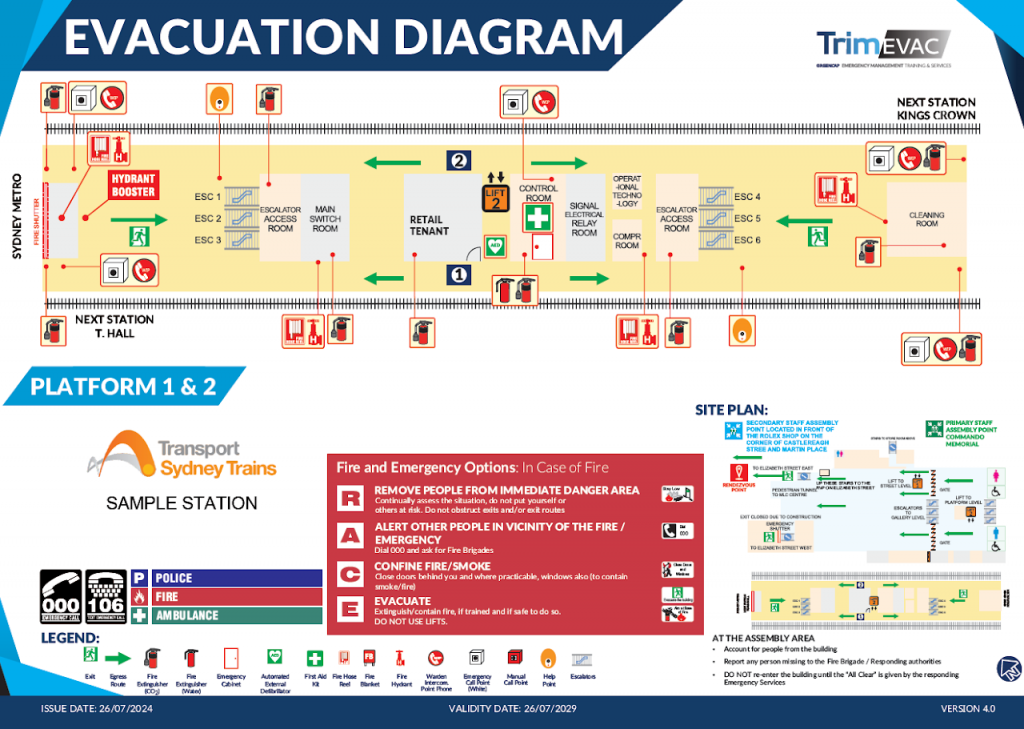
Frequency: Evacuation drills every 12 months; diagrams must be kept up to date; exit pathways to be clear from any storage or trip hazards at all times.

Why: Ensures staff know how to exit safely in an emergency and prevents delays in a swift escape caused by blocked pathways. It is also a legal requirement under WHS laws.

How: Educate site staff on the emergency procedures and good housekeeping practices, display evacuation diagrams and station manager contact details, know how to raise alarms to Station Management & daily routine to inspect pathways to keep them free of obstructions, storage, or trip hazards. Proactively remove any storage items in the way of emergency pathways or doors.
Note: Exit pathways include stairs, external doors, back of house (shared areas), doors with emergency signage, storage rooms and general traffic areas. 


Blocked exits pathways could potentially prevent your site from obtaining Annual Fire Safety certification (AFSS).  

Evacuation and Emergency Response Planning

Readiness for swift responses to emergencies in communication and action procedures.


What: Regular emergency evacuation drills, clearly posted evacuation diagrams, and clear instructions for staff and contractors, including Train Station management communications.

Frequency: Drills must be conducted at least every 12 months or when new staff are hired; Evacuation diagrams must be kept current; communication protocols especially between train station managers should be reviewed and reinforced regularly.

Why: Well-practiced staff and visible instructions reduce panic and ensure safe evacuation, especially in high-traffic areas like train stations.

How: Schedule and document evacuation drills involving all key personnel, display up-to-date evacuation diagrams at key access points, and brief all staff and contractors on emergency procedures. Ensure station management contact numbers are current and displayed incase of emergency.

Unobstructed Fire Safety Equipment

Keeping fire equipment unobstructed from storage items and correctly mounted ensures quick access and equipment working efficiently.

What: Equipment such as fire extinguishers, hose reels, fire blankets, hydrants, sprinkler heads and smoke detectors must be clearly visible, easily accessible and correctly mounted.

Frequency: Access should be checked daily to ensure nothing is blocking or covering the equipment at all times. Extinguishers are to be on the mounting hook at all times.

Why: Blocked or hidden equipment can delay emergency response and increase risk to life and property.

How: Train staff to ensure any storage and furniture is away from fire protection equipment at all times. Maintain compliance with Australian Standard AS 1851 and WHS regulations.

Site Visitor Register & Inductions

Recording visitors and performing site inductions to your premises ensures security, safety and compliance.

What: Maintain logs of all visitors & contractors that visit your tenancy. Including an induction to your site, highlighting potential hazards present (E.g. Electrical switch board location)
Frequency: Records should be updated immediately upon each visit & induction and retained for a minimum period as required by WHS regulations.
Why: Keeping these records ensures everyone onsite is aware of safety procedures, ensures security of your site, and supports legal compliance.
How: Use a secure digital or paper-based system to track visitor and induction details. Regularly review and securely store records in line with WHS and privacy requirements. Ensure all visitors and external contractors sign in with the Station Master prior to any works being conducted in your premises.
Note: Ensure the visiting contractor is wearing and displaying a ‘Visitor’ lanyard provided by the station master, at all times whilst on site.

Incident Management

All incidents and near misses must be promptly reported to ensure safety improvements and compliance with WHS laws. 


What: Report any accidents, injuries, hazards, or near misses that occur on site.

Frequency: Report immediately after the event or as soon as it is safe to do so.

Why: Reporting helps identify risks, prevent future incidents, and ensures timely response and investigation.

How: Notify the Station Master and JLL Property Management promptly using the established reporting procedures. Document all details accurately and participate in any follow-up actions or investigations as required by WHS regulations.
Note: JLL Property Management are here to help. Please contact JLL CSC if you have any questions.

For any immediate emergencies that require emergency services (Ambulance, Police, Fire Brigade), call 000 first and then notify Station Management.

Gas Cylinder Safety

Liquid Propane Gas (LPG) cylinders or Butane should not be stored or used inside commercial kitchens as per NSW SafeWork guidelines.

What: LPG or Butane gas cylinders being used within commercial kitchens or indoors.

Frequency: LPG or Butane gas storage on site is prohibited always.

Why: LPG gas and butane is extremely flammable and heavier than air, leaked gas sinks to the floor and may accumulate unnoticed, increasing risk. Leaks can cause fire, explosion, asphyxiation, carbon monoxide poisoning, property damage, disruptions to the rail network operations, serious injury and death.

How: Stop using LPG or Butane gas and remove it off site immediately and please contact JLL Property Management for further advice on compliant gas connections for your tenancy. 

Power Boards & Double Adapter Awareness

Safe use of electrical power boards and electrical safety awareness within your tenancy.

What: Use of power boards or double adapters in retail or commercial kitchen tenancies.

Frequency: The use of double adapters is not recommended at all times. Power boards may only be used temporarily and in accordance with NSW SafeWork guidelines.

Why: Overloading or misuse can cause overheating, electrical shock, sparks, or fire. Double adapters do not have overload protection and increase the risk of electrical faults, burns, property damage, serious injury, or death. In kitchens, heat, moisture, and grease increase these risks.

How: Use fixed, permanent outlets wherever possible. If a power board is required, ensure it has overload protection, is kept off the floor, away from heat/moisture, and not “daisy chained” with other boards or extension leads. Inspect regularly for damage. Remove and replace damaged equipment immediately or annually.

JLL Property Management Customer Service Centre (CSC)

JLL Property Management are here to help provide guidance and assist you in ensuring your establishment is a safe working environment and complies with WHS Laws. 

JLL CSC Contacts

Phone : 1300 086 679
Email : TAM.CSC@JLL.COM

Official WHS & Fire Safety Reference Links (NSW)

SafeWork NSW – Work Health and Safety
https://www.safework.nsw.gov.au
The primary regulator for workplace health and safety in NSW, providing codes of practice, PCBU responsibilities, guidance, and safety checklists.

SafeWork Australia – National WHS Framework
https://www.safeworkaustralia.gov.au
The national body that develops model WHS laws adopted by NSW and other states. Includes guidance on electrical safety, emergency planning, and more.

NSW Fire and Rescue – Fire Safety Guidelines
https://www.fire.nsw.gov.au
Provides information on fire safety inspections, equipment standards, and fire safety responsibilities for businesses and public spaces.

NSW Legislation – Work Health and Safety Regulation 2017
https://legislation.nsw.gov.au/view/html/inforce/current/sl-2017-0404
The full legal text outlining WHS requirements, including emergency plans, risk management, and compliance duties for PCBUs.

This is a basic guide only and exclusively created for Sydney Trains Transport Asset Manager (TAM) tenants. For more information, please refer to your lease or visit the SafeWorkNSW or NSW Government websites.

All images used on this site are for illustrative purposes only. We do not claim ownership of any third-party images unless stated otherwise. All rights belong to their respective copyright holders. If you are the owner of an image and would like it removed or credited, please contact us.

Version 1  – Created by Philip Villarroel July 2025

    Etiam magna arcu, ullamcorper ut pulvinar et, ornare sit amet ligula. Aliquam vitae bibendum lorem. Cras id dui lectus. Pellentesque nec felis tristique urna lacinia sollicitudin ac ac ex. Maecenas mattis faucibus condimentum. Curabitur imperdiet felis at est posuere bibendum. Sed quis nulla tellus.

    ADDRESS

    63739 street lorem ipsum City, Country

    PHONE

    +12 (0) 345 678 9

    EMAIL

    info@company.com